
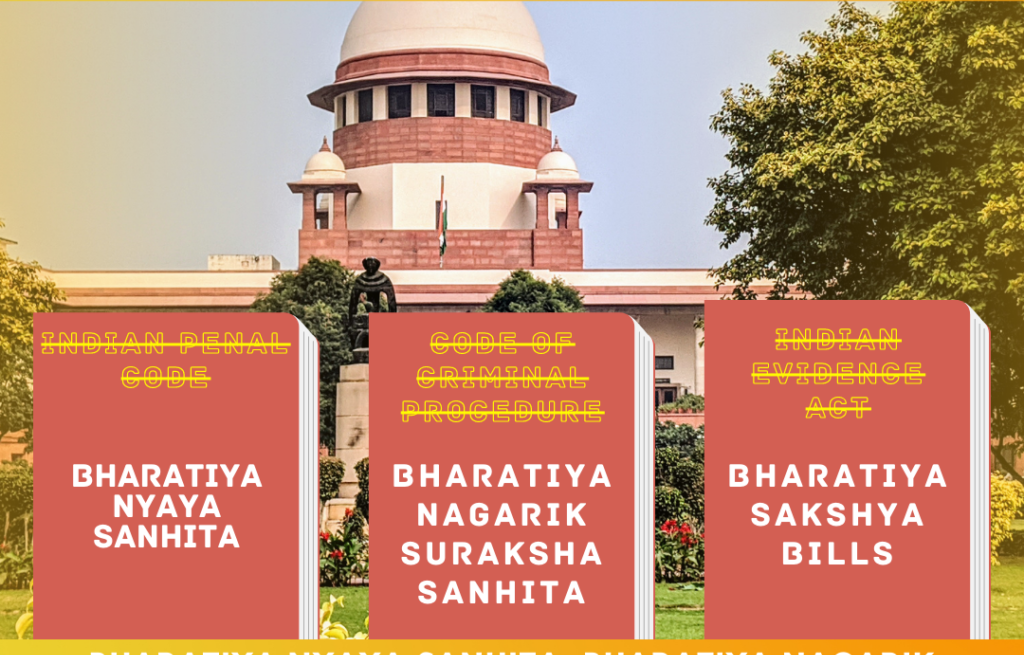
OSTENSIBLY to liberate the Indian legal system from its colonial past, the Modi-led BJP government introduced three bills in the Lok Sabha aimed at revamping the existing criminal laws. The bills targeted the Indian Penal Code (1860), the Code of Criminal Procedure (1973), and the Indian Evidence Act (1872), two of which date back to the British era. The initial presentation occurred on August 11, 2023, and later, during the winter session of parliament, these bills were replaced with new ones, with some amendments.
These three criminal law bills were introduced with the stated objective of “overhauling the criminal justice system in India” and “shedding the vestiges of British colonial rule”.
By naming the bills in Hindi while retaining the contents in English as the Bharatiya Nyaya Sanhita Bill, the Bharatiya Nagrik Suraksha Sanhita Bill, and the Bharatiya Sakshya Bill, there is a discernible effort towards Hindi domination which may pose challenges in the courts of a multi-lingual country like India. The Madras Bar Association has formally raised objections, and the chief minister of Tamil Nadu has characterised this move as an attempt at ‘Hindi colonisation in the name of decolonisation from the British era.’
Related articles


Upon comparing the existing laws with the introduced bills, it becomes evident that extensive powers, including ‘preventive detention,’ have been vested in the police. The Bharatiya Nagrik Suraksha Sanhita Bill places a pronounced emphasis on arbitrary ‘crime prevention’ at the expense of ‘individual liberty.’ The recently published booklet by the Association for Protection of Civil Rights (APCR), which serves as the source for this write-up, highlights the risk of undermining the doctrine of due process, as consistently emphasized by the Supreme Court in various cases such as RC Cooper vs. Union of India and Maneka Gandhi vs. Union of India.
These bills introduce ‘terrorism clauses’ into the Penal Code, despite the existence of specific legislation on terrorism-related activities such as the Unlawful Activities (Prevention) Act of 1967 (UAPA). Moreover, certain limited safeguards present in the UAPA have been removed in the clauses incorporated into the penal code.
Specifically, the Bharatiya Nagrik Suraksha Sanhita Bill encompasses provisions that raise concerns: (1) Handcuffing – contrary to judgments by the Supreme Court; (2) Preventive Detention – susceptible to rampant misuse by the police; (3) Extended Police Custody – permits detention beyond the initial 15 days; (4) Trial in Absentia – runs counter to the principle of natural justice; (5) Sentence Commutation – the revised section limits the government’s power to commute sentences; (6) Specimen Production – grants arbitrary power to the magistrate to order specimen production without arrest; (7) Bail Provisions – the absence of updated provisions contradicts recommendations by the law commission and judicial decisions; (8) Compensation for Wrongful Prosecution – the bill lacks this provision; (9) Search and Seizure of Electronic Devices – lacking a legally mandated framework, such search and seizure actions pose challenges.
The Bharatiya Nyaya Sanhita Bill introduces provisions that raise concerns: Re-introduction of Sedition Law: The home minister mentioned removing the colonial sedition law during the bill’s introduction, but it is retained through reference to the publication as ‘seditious matter.’ Contrary to what has been propagated, the bill does not represent a transformative, post-colonial breakthrough. In essence, it contains more restrictive provisions that allow the State to stifle democratic expression.
The inclusion of ‘Terrorist Offence’ in the bills is not required as a new offense, as it is already covered by the Unlawful Activities (Prevention) Act (UAPA).
The provisions in the Bharatiya Sakshya Bill have the potential for misuse, particularly in the context of “confession made to police officers in or outside police custody or anyone other than police, in police custody,” under the guise of ‘discovery statements.’
WIDE ARRESTING POWERS TO POLICE
The Nagrik Suraksha Sanhita reads, “If such person forcibly resists the endeavour to arrest him, or attempts to evade the arrest, such police officer or other person may use all means necessary to effect the arrest.” This grants the police officer the authority to use “all means necessary” for the arrest, akin to the powers vested in military personnel under the draconian Armed Forces (Special Powers) Act.
The section on the power of Preventive Detention in the bills bears a resemblance to the power of arrest under the Unlawful Activities (Prevention) Act (UAPA).
The Bills include provisions stating, “(1) All persons shall be bound to conform to the lawful directions of a police officer given in fulfillment of any of his duty under this Chapter; (2) A police officer may detain or remove any person resisting, refusing, ignoring, or disregarding to conform to any direction given by him; and (3) may either take such person before a Judicial Magistrate, removing the present position of ‘when the occasion is past’ ‘within a period of twenty-four hours.’”
As of now, the Criminal Procedure Code (CrPC) does not contain such broad preventive detention powers based on disobeying police orders. It is vested without giving any time limit for such detention. These provisions in the bills violate Article 22 of the Constitution.
Section 167(2) of the Code of Criminal Procedure states, “The Magistrate to whom an accused person is forwarded under this section may, whether he has or has no jurisdiction to try the case, from time to time, authorize the detention of the accused in such custody as such Magistrate thinks fit, for a term not exceeding fifteen days in the whole; and if he has no jurisdiction to try the case or commit it for trial, and considers further detention unnecessary, he may order the accused to be forwarded to a Magistrate having such jurisdiction.”
Section 187(2) of the Bharatiya Nagrik Suraksha Sanhita states that the 15-day police custody can be sought as a whole or in parts at any time during the initial 60 days (if the offence is punishable with death, imprisonment for life, or imprisonment for a term of not less than ten years) or during the initial 40 days (in respect of other offences).
This means that the investigating agency can seek police custody for 15 days in different parts, allowing the extension of police custody beyond the initial 15 days, up to a total of 40/60 days during the entire custody period of 60/90 days for investigation.
This provision dilutes the 15-day police custody limit under Section 167(2) of the CrPC, which is a crucial safeguard against custodial abuse. The Supreme Court has ruled that no further police custody is permitted once 15 days lapse, even if a total of 15 days is not exhausted earlier. As per the existing interpretation of the CrPC, after the first 15 days have elapsed, no one can be sent to police custody, even if the arrested person was not sent to police custody for a total of 15 days. By increasing the permitted police custody duration, the bills enhance the powers of interrogation while weakening protections against torture or coercion of the accused in custody.
This marks the most alarming change in procedural law, as custodial violence and deaths continue to be concerning issues in India.
There is also a notable shift in the level of executive satisfaction required to “use armed forces to disperse assembly.” Previously, only the “Executive Magistrate of the highest rank who is present” could request the deployment of armed forces. Now, the “District Magistrate or any other Executive Magistrate authorised by him, who is present” is also given the power to permit deployment.
In summary, these three new criminal laws have the potential to be misused, to usher in a police state.
Courtesy: People’s Democracy